
- Colder 2023 winter temps led to stronger summer YSBCW than in 2020.
- 2023 saw colder central but warmer coastal waters compared to 2020.
- Higher 2023 YSBCW volume drove further southward extension than in 2020.
Figure 1. Bottom water temperature from January 1 to December 31, 2023.
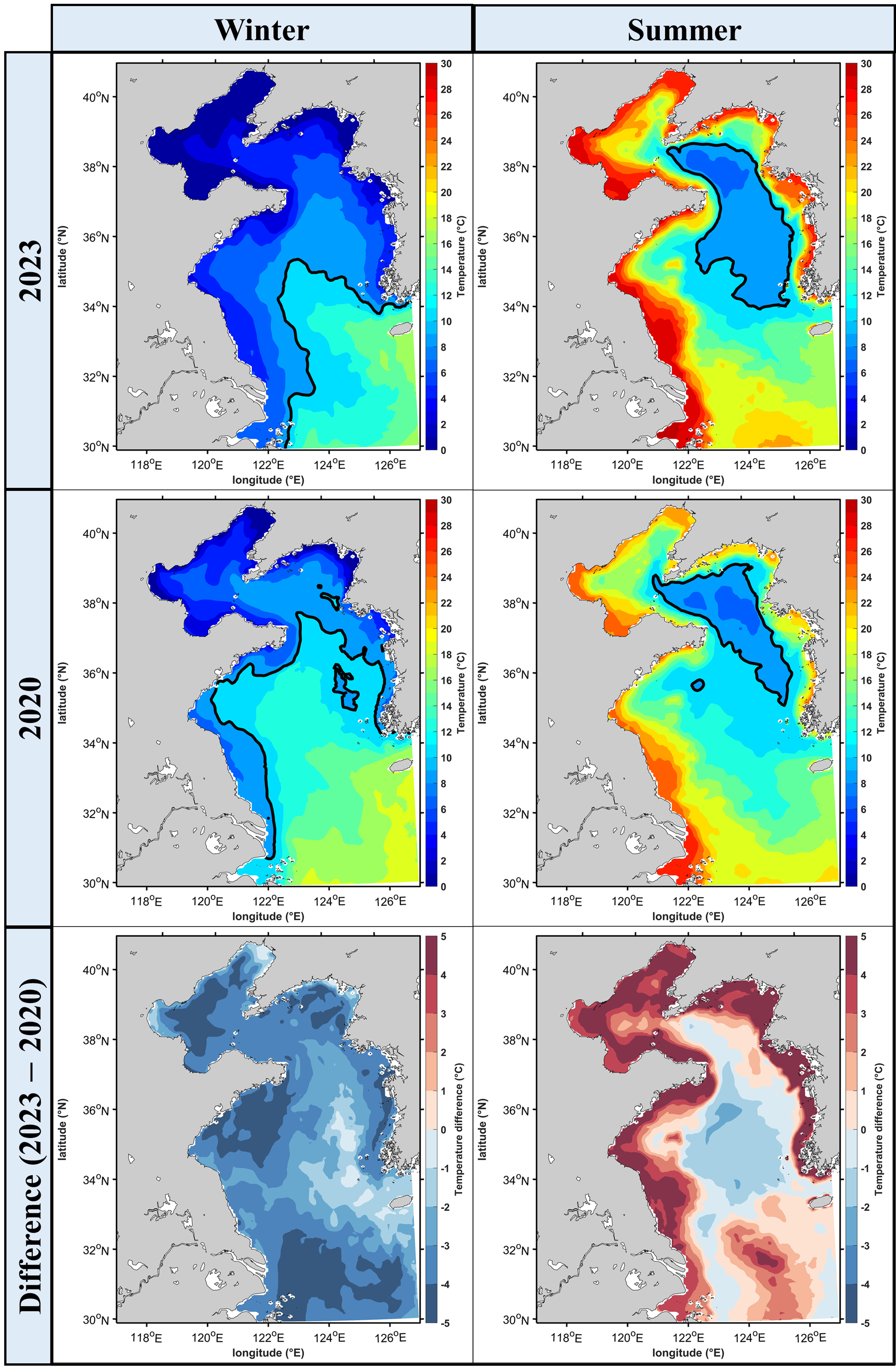
Figure 2. (a) and (c) represent the average bottom water temperature for January and February (winter) in 2023 and 2020, respectively. (b) and (d) represent the average bottom water temperature for July and August (summer) in 2023 and 2020, respectively. (e) and (f) represent the differences in bottom water temperature during the winter and summer between 2023 and 2020. The black line is the 10 deg C contour. In winter 2023, the bottom water temperature was lower. In summer 2023, the bottom water temperature was lower in the open sea, but near the coast was higher.
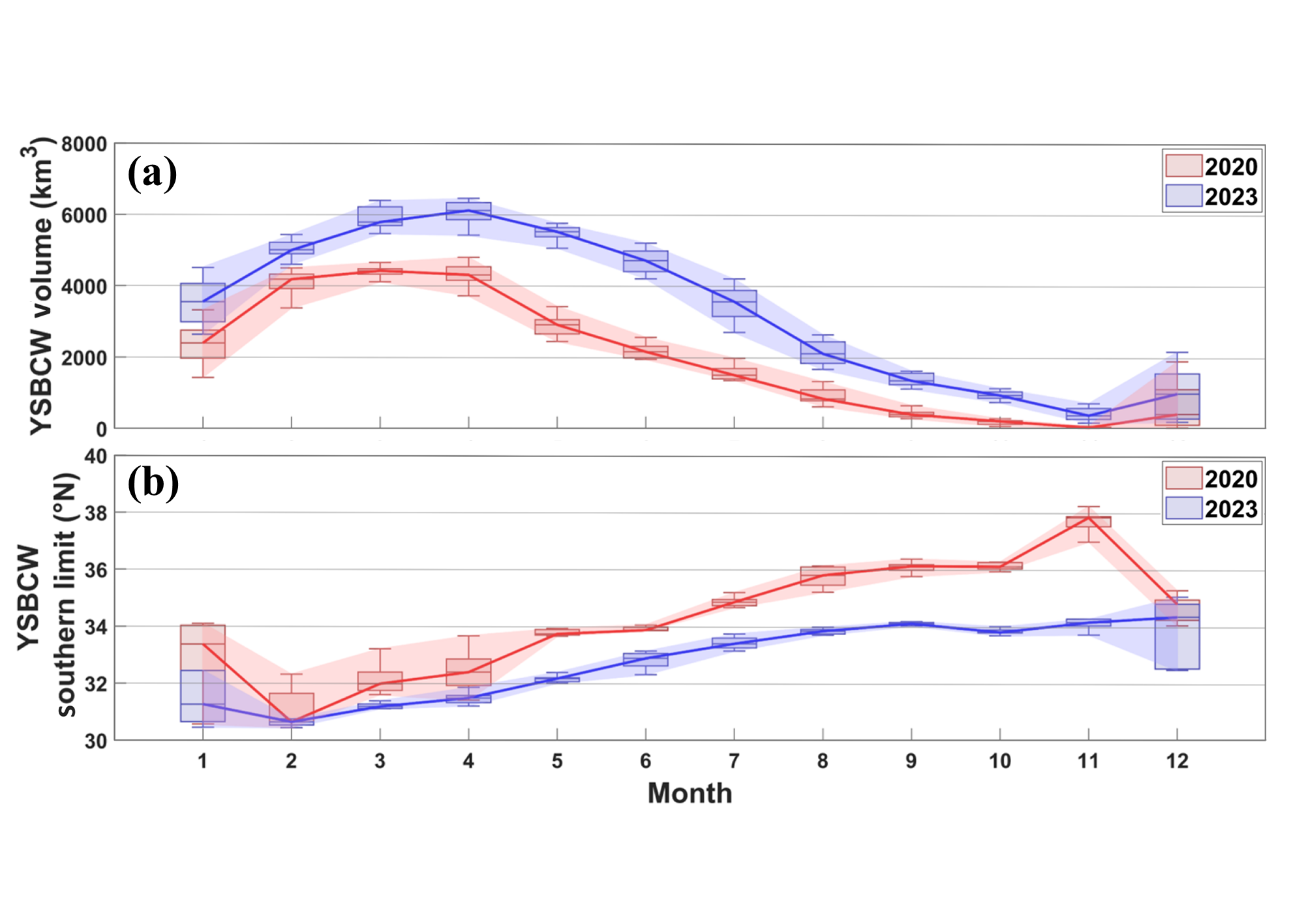
Figure 3. (a) represent the monthly YSBCW volume variation in 2023 and 2020, and (b) represent the monthly YSBCW southern limit variation in 2023 and 2020. In 2023, there was more YSBCW volume compared to 2020, and the southern limit of YSBCW extended southward compared to 2020.
This study investigates variations in the volume and southern limit of the Yellow Sea Bottom Cold Water (YSBCW) within the Yellow Sea and northern East China Sea using HYCOM temperature data. The analysis focuses on 2020 and 2023, representing years with relatively weak and strong YSBCW development, respectively. Comparisons of winter bottom temperatures reveal that 2023 was consistently colder across the entire Yellow Sea than 2020. A cold water mass, exhibiting temperature differences of up to 3°C, formed during winter and persisted in the central Yellow Sea bottom throughout the spring and summer months.
This persistence is attributed to the fact that a significant volume of YSBCW (<10°C) remained in the central Yellow Sea until November 2023, whereas much less remained in November 2020. The southern limit of the YSBCW also extended further toward lower latitudes in 2023 compared to 2020. These disparities originate from the degree of cooling during the winter formation phase: in 2020, the Yellow Sea did not cool sufficiently compared to 2023, resulting in a smaller volume of YSBCW formation. Consequently, its southward expansion was limited, and the water mass decayed more rapidly. The weakened formation of YSBCW in 2020 is likely driven by factors such as winter air-sea heat flux and the intrusion of the Yellow Sea Warm Current.
DOI Link: -
- 사업명
- 씨그랜트사업 5단계
- 발주처
- 해양수산부